


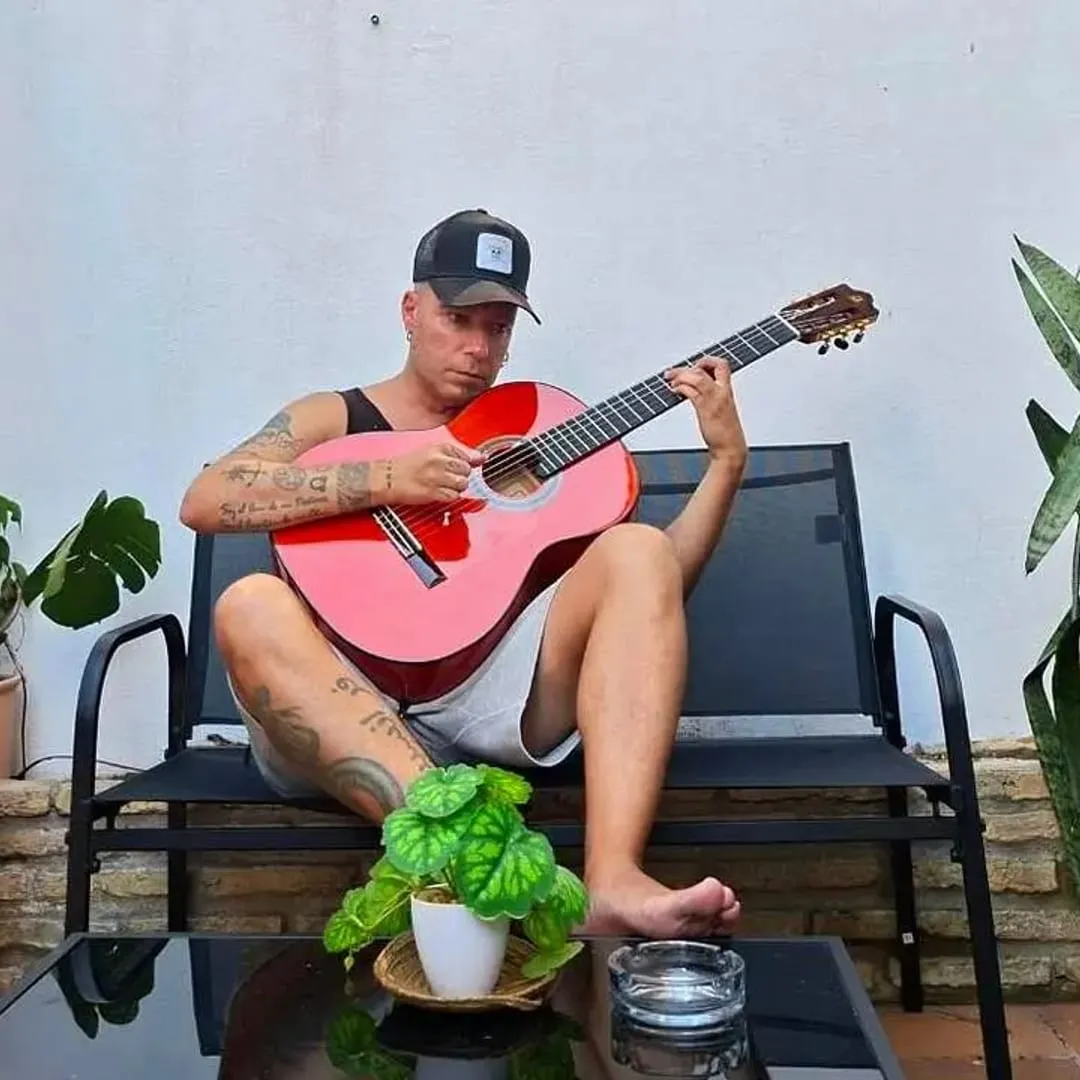
Raúl Cabrera
Guitarist, composer and music producer
San Fernando, Cádiz, Spain
Favourite admira guitar(s):
From the first chords to writing songs for major artists.
Music has been part of Raúl Cabrera Fernández's life since he was a child. Born in San Fernando (Cádiz), he grew up surrounded by sounds and references that would end up defining his musical identity. It was his father and his cousin Robe who taught him his first guitar chords and passed on to him a love for the musical roots of his land: the Carnival of Cádiz and the flamenco of Camarón de la Isla. At just 11 he was already playing the guitar and starting to write his own songs. What began as a passion grew with him until it became his profession and a way of understanding life.
At 18 he began composing more professionally and making his way as a session musician. His first steps in the industry came with Los Rebujitos, an experience that took him into the world of recording, touring and writing for other artists. In 2007 he took part as a vocalist in Docambe, a band formed with Lucas, formerly of the group Maita Vende Ca, releasing his first record, produced by Ludovico Vagnone. That stage was another important step in a career that was beginning to take shape.
That same year brought one of the first major recognitions of his career. “Abuelo”, written by Raúl and performed by María Carrasco, went Gold and marked a turning point in his professional path. That recognition opened new doors in publishing and recording and confirmed that his talent for writing songs could go much further.
Since then, his work as a composer has been present in the repertoire of many artists on the Spanish music scene. Andy & Lucas, Andy, Marta Santos, Los Rebujitos, María Carrasco, María Toledo, Sarayma, Decai, Antoñito Molina, Rasel, Demarcos Flamenco, Kiko Rivera, Álvaro García, Moisés Losada, Nuria Fergó, Salistre, Duende Callejero, Kike & Manu, Juan Cid, Gonzalo Alhambra, Iván Gallego Canelita and Paco Candela are some of the performers who have used his compositions. He has also taken part in projects with international reach, such as CNCO, alongside Pinto and Juanma Leal, and in productions linked to artists such as Lali Espósito and Cirque du Soleil.
His career has earned important recognition: four Gold Records and four Platinum Records for different compositions, as well as a Latin Grammy nomination in 2021 for his part in “Mirarte a la Cara”, performed by Paco Candela. Among the works behind these results are four songs by Andy & Lucas: “El Último Beso”, “Tú Háblale”, “Para Que Bailes Conmigo” and “La Última Oportunidad”, which together passed 75 million plays on digital platforms.
But Raúl's development has not been limited to composing. Over the years he has also built a solid side as a session musician, backing vocalist and production assistant, working with different publishers and record companies. His experience has allowed him to know music from different angles: from performing and recording to building arrangements and producing songs. In 2024 he also extended his work to film with “Primavera de Colores”, a song written with Sarayma and Edu Prieto for the film La Reina del Convento, and in 2026 he wrote the main song for the film Las 3000 maravillas.
There is, however, one part of his musical identity that remains especially tied to his origins: the Carnival of Cádiz. A passion that began at 14 and that he has kept for more than two decades as an author and composer for carnival groups, taking part in those of Juan Carlos Aragón, the Hermanos Carapapa, Kike Remolino and Antonio Rivas. Within that carnival world, in recent years he has worked with Miguel Ángel García Argüez, known as El Chapa, in comparsas such as Los Renacidos, Los Esclavos, Los Colgaos, La Tribu and El Desguace. In recognition of his career and his contribution to the Carnival of his city, Raúl received the Timón de Oro in 2024.
Raúl Cabrera's path speaks of perseverance, learning and growth. From that child discovering the guitar with his father and his cousin to the professional who today works with artists, musicians and producers of different styles and settings. A career built song by song, in which flamenco, pop, roots music and the Carnival live together with one same restlessness: finding melodies able to move people and connect with them.
The guitar has been the thread running through all that road. Much more than an instrument to play, it has been a companion in his personal and professional growth, a tool for experimenting, composing and giving shape to new ideas. At admira we want to get closer to that relationship with the six strings, to learn about the influences that have shaped his sound and to find out what someone who has devoted his life to making music — both for himself and for other artists to make their own — looks for in a guitar today.
Follow Raúl Cabrera on:
Interview
admira: Your father and your cousin taught you your first guitar chords when you were a child and, since then, the instrument has gone with you through your personal and musical development. What do you remember of those early years? Has your way of relating to the guitar changed much since then?
Raúl: I have beautiful memories of those years; I never thought that what began as a hobby would become my passion and my profession. The guitar is my faithful companion, the one that always listens to me, the one that gives me the best and at the same time the worst; sometimes we love each other and sometimes we hate each other, hahaha. It is a precious relationship, the one I have with my guitar, and I'm sure it will always be with me.
admira: You have written songs for artists of very different styles and personalities. When you sit down to create, what role does the guitar play in your creative process? Do you usually start from some chords, a melody, a rhythm or an idea you develop on the instrument?
Raúl: Of course, the guitar is everything for me in this business of writing. Everything starts from a melody or a chord progression, and from there I begin to work out the lyric to give shape to that melody, and that is how I structure and build the song.
admira: Flamenco and the Carnival of Cádiz are part of your roots, but your career has also taken you to work with pop and other genres. How do all those influences live together in the way you play? What sounds, resources or nuances of the guitar do you consider essential to find your own musical identity?
Raúl: I always try to mark out and define my style very clearly. I think that is what makes you different in this music business. Obviously each style has its touch and its way of being played, but I like to play with chords that are very melodic, which is what I enjoy and what has brought me this far.
admira: After so many years working in recording studios, on stages and on projects with other artists, you have surely had the chance to know and try very different guitars. What do you especially value in an instrument? How important are the sound, the comfort, the feel and the response of the guitar when you write or record?
Raúl: Above all, the first thing I look at is comfort, because spending so many hours with the instrument is what I value most, so that the hours I spend playing and writing are easier and my hand doesn't get tired. For me it is essential that the instrument is comfortable and that it has a tension that suits my way of playing.
admira: If today you could design a guitar entirely made to measure, one that brought together everything you have learnt in these years as a guitarist and composer, what would it be like? What sonic personality would it have, what kind of woods would you choose and what features could not be missing from that ideal instrument?
Raúl: I would like the sound to be bright and trebly, with strength. The woods would be cypress and rosewood, which are the ones I have worked with most. And the features: going back to the previous question, comfort and a clean sound.
Listen to Raúl Cabrera on the admira Spotify playlist:
Spotify by admira